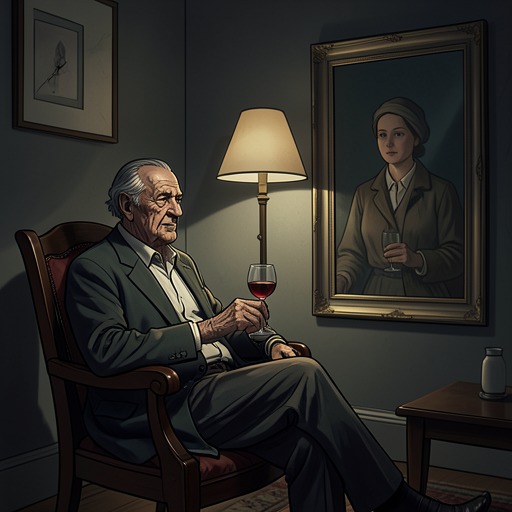
Time and aging measured through love
Love in the Time of CholeraTime and aging measured through love is the novel’s way of making elapsed years legible through attachment: Florentino Ariza recognizes time most clearly in the changes he observes in Fermina Daza, while his own life seems suspended around his continuing love for her. The idea links his delayed reckoning with age to Fermina’s changing experience of marriage, widowhood, and renewed love. It also gives the novel’s long chronology an intimate measure: years become visible in remembered encounters, altered bodies and habits, and the knowledge that love is lived under the pressure of mortality.
Time Measured by Fermina
For Florentino, time passes almost without notice until it appears in Fermina. After his mother’s death, the routines that structure his weeks return: work, meetings with his mistresses, dominoes at the Commercial Club, books of love, and Sunday visits to the cemetery. Routine had protected him from awareness of age. One December Sunday, however, he sees swallows on newly installed electric wires and connects the present to the deaths of his mother and Olimpia Zuleta and to Fermina’s letter, received decades earlier, promising that she would always love him. The recurring calendar of his life suddenly discloses its distance from that earlier moment.
The realization is sharpened by an ordinary encounter: Florentino meets a couple whose marriage had followed from letters he wrote, but fails to recognize their oldest child, his godson. His casual astonishment that the boy has grown into a man cannot disguise what he has missed. At forty, a doctor had already attributed Florentino’s vague pains to age, yet he had not taken that judgment as a fact about himself. His personal chronology had been organized around his youthful love for Fermina, not around the accumulating evidence of years.
The swallows bring that evidence together. Reviewing the loves and dangers of his past, and the events that had sustained his determination to be with Fermina, Florentino finally understands that his life has been passing. The recognition arrives as a physical shock: he drops the garden tools and leans against the cemetery wall. His astonished remark that it had all happened thirty years earlier names the gap between the events as he carried them in memory and the years that had elapsed beyond that memory.
Encounters as Markers of Elapsed Years
Florentino’s sense of time also forms through fleeting views of Fermina. Three days after the balloon expedition returned to port, he saw her again at a cycling exhibition sponsored by her husband. She rode a striking velocipede with a high front wheel and a small rear one; her red-trimmed trousers scandalized older women and unsettled men, while her skill drew attention. For Florentino, such images could later return unexpectedly and then disappear, leaving longing behind. Their importance lies not in changing the course of their relationship but in giving his life a series of remembered points by which its passage can be felt.
At Don Sancho’s Inn, the distance between watching and sharing becomes especially clear. Seated alone in a remote corner, Florentino sees Fermina reflected in a large mirror as she dines and talks with her husband and other couples. For more than an hour he observes this passing scene without being seen, then waits until the group leaves. He spends nearly a year persuading the inn’s owner to sell him the mirror. He wants it not for its elaborate frame but for the place in it where Fermina’s reflection had appeared. A brief encounter becomes a private keepsake, turning memory into an object that holds a moment even as time moves on.
The mirror scene also sharpens the contrast between Florentino’s singular attachment and Fermina’s shared life. He can witness only a fragment of her evening; the ease and harmony of her life with Juvenal Urbino remain visible to him from outside. His experience of time is therefore relational but not reciprocal: Fermina’s changing presence marks his years even when their lives do not move together.
Different Life Courses, Different Measures
The novel’s account of aging does not equate a long marriage with unchanging feeling. After three decades together, Fermina and Juvenal have become so familiar with one another that they sometimes anticipate each other’s thoughts or words. Their closeness has been formed through daily misunderstandings, anger, mutual sharpness, and moments of shared happiness. The account presents their love as something developed through the ordinary work of living together, not simply preserved from the beginning of their relationship. They have reached a stage in which they feel they are on the other shore, having endured adversity together.
That shared history also makes their age difference consequential: Juvenal is ten years older and, in old age, seems to Fermina to stumble through it alone and with greater frailty. She clings to him when he needs her, and their accumulated knowledge of one another becomes both a measure of duration and a form of companionship. Their marriage supplies a contrast to Florentino’s decades of waiting. He has held his life to a love that was not lived with Fermina; she and Juvenal have made a life whose intimacy was built in shared time.
The norms surrounding age further shape what love can mean in public. Florentino is fifty-six and still regards his years as well lived because they have been years of love, but his society treats youthfulness and age as matters of social dignity as much as biology. Men dress and present themselves according to age-coded expectations; for women, the social categories are especially narrow, separating those considered marriageable from those designated as spinsters, while married women, mothers, widows, and grandmothers are treated as another class altogether. Against these conventions, Florentino’s continued attachment and later courtship challenge the assumption that love belongs only to youth.
Memory, Widowhood, and Renewal
After Juvenal’s death, Fermina initially grieves through the habits and memories of a long marriage. Even when she tries to put his belongings behind her, the memory of him persists, including the small things that had irritated her. The process of bereavement does not erase the relationship; instead, she resolves to continue living while remembering him as though he had not died. As grief gradually loosens, another presence becomes difficult to dismiss: Florentino, whose renewed declaration of love had first seemed to her an impertinence and perhaps a threat.
Fermina’s return to the past is not straightforward nostalgia. The familiar places of her youth have changed: the park’s trees and statue are gone, and the house where she lived has fallen into ruin. Those alterations make it difficult for her to picture Florentino as the vulnerable young man she once knew, or to reconcile that memory with the old man whose unexpected declaration had disturbed her mourning. The past survives, but not as a place she can simply re-enter. Her memories of Florentino carry sorrow as well as the recollection of first love.
Her cousin Hildebranda Sánchez helps bring the distance between youth and old age into view. During a visit, Hildebranda produces a faded photograph of the two of them dressed as old-fashioned ladies. They can still recognize their younger selves, though the portrait has nearly vanished. The photograph makes aging visible as a change in both appearance and memory: the young women remain identifiable, yet belong to a time neither can recover. Their conversation also returns to Florentino, whose life Hildebranda has long associated with her own memories.
Love Near the End of Life
The late-life relationship between Fermina and Florentino is judged differently by different generations. Ofelia Urbino treats their friendship as scandalous and insists that love at their age is revolting. Fermina responds by ordering her to leave the house and never return. The moment establishes that Fermina will not accept her daughter’s prejudice as the rule by which her own old age must be lived. The conflict is not simply about reputation: it is about whether affection between two elderly people is permitted to count as love.
The river voyage gives that love its mature form. As arrival approaches, Fermina imagines other journeys with Florentino, free of luggage and social obligations. At a party aboard ship, she declines his invitation to dance their private waltz, but keeps time with the music. Later, they make love quietly, as experienced grandparents; the novel presents the encounter not as a return to youthful courtship but as a passage beyond its trials. They are together in silence, past the pitfalls of passion and the disillusionments of hope, with love made more solid by its proximity to death.
The voyage thus brings the concept to its fullest expression. Time has not restored the lovers to their youth or erased their separate histories. Instead, their years of waiting, marriage, bereavement, and return have changed what closeness means. At the end, love is measured neither by the freshness of a beginning nor by a promise that time can be stopped, but by the intimacy that remains possible when life’s limits are clearly in view.